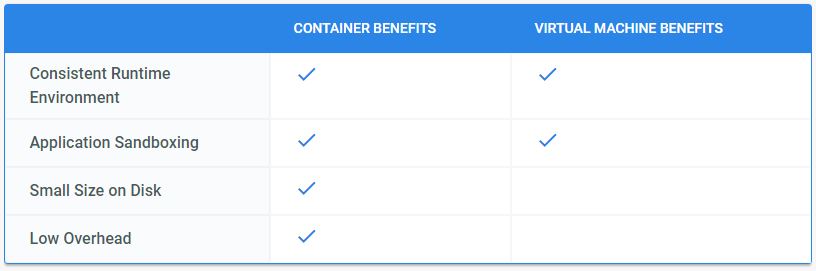
Thùng chứa – Container cung cấp một cơ chế đóng gói, trong đó các ứng dụng có thể được trừu tượng hóa từ môi trường mà chúng sẽ thực sự chạy. Việc tách rời này cho phép các ứng dụng dựa trên container được triển khai dễ dàng và nhất quán, bất kể môi trường đích là trung tâm dữ liệu riêng, public cloud hay thậm chí là máy tính xách tay cá nhân của nhà phát triển (developer).
Cơ chế container hóa cung cấp một sự phân tách rõ ràng các vấn đề cần giải quyết, vì các developer tập trung vào logic ứng dụng và các ràng buộc của chúng, trong khi các nhóm vận hành IT có thể tập trung vào vấn đề triển khai và quản trị mà không bận tâm đến các chi tiết của ứng dụng như version và các cấu hình chi tiết của chúng.
Đối với những ai đã quen thuộc với môi trường ảo hóa, các container thường được so sánh với các máy ảo (VM). Bạn có thể đã quen với máy ảo: một hệ điều hành guest như Linux hoặc Windows chạy trên hệ điều hành host có quyền truy cập ảo vào phần cứng bên dưới. Giống như các máy ảo, các container cho phép bạn đóng gói ứng dụng của mình cùng với các thư viện và các thành phần phụ thuộc (dependencies) khác, cung cấp các môi trường riêng biệt để chạy phần mềm của bạn. Tuy nhiên, như bạn sẽ thấy bên dưới đây, những điểm tương đồng sẽ dừng lại ở đây khi các container cung cấp một thành phần nhẹ hơn rất nhiều cho các developer và các nhóm IT Ops làm việc. Điều đó mang lại vô số lợi ích.
What Casimatic Explains About the Canadian Online Casino Industry
The Canadian online casino industry has undergone a remarkable transformation over the past two decades, evolving from a loosely regulated grey market into a more structured, provincially governed ecosystem. Understanding this evolution requires looking at platforms that have emerged to serve Canadian players with a degree of transparency and market awareness. Casimatic, a casino review and comparison platform operating in the Canadian space, offers a particularly instructive lens through which to examine how the industry has matured, what players now expect, and where regulatory frameworks are heading. By analyzing what Casimatic covers and how it approaches its subject matter, observers can gain meaningful insight into the broader dynamics shaping online gambling in Canada today.
The Regulatory Landscape and How Review Platforms Navigate It
Canada’s approach to online gambling regulation is notably decentralized. Unlike countries with a single national gambling authority, Canada delegates much of its regulatory responsibility to individual provinces. This has created a patchwork system where British Columbia, Ontario, Quebec, Manitoba, and Alberta each operate their own lottery and gaming corporations, while the federal Criminal Code provides the overarching legal framework. The landmark shift came in April 2022, when Ontario launched iGaming Ontario, becoming the first province to open a regulated, competitive online casino market to private operators. This allowed licensed international and domestic operators to legally offer their services to Ontario residents under strict compliance requirements.
Casimatic’s coverage reflects this complexity directly. The platform distinguishes between operators licensed under iGaming Ontario and those operating under offshore licenses from jurisdictions such as Malta, Gibraltar, Curaçao, and Kahnawake. This distinction matters enormously to Canadian players, as provincial licensing comes with consumer protections, responsible gambling mandates, and dispute resolution mechanisms that offshore-licensed sites may not consistently provide. Review platforms that fail to make this distinction do a disservice to their audiences, and Casimatic’s attention to licensing status demonstrates a level of editorial responsibility that speaks to the maturation of the Canadian market itself.
The regulatory conversation in Canada is also evolving at the provincial level beyond Ontario. British Columbia’s PlayNow platform has long operated as a government-run monopoly, while Alberta has signaled interest in exploring a more open market model. Quebec’s Loto-Québec continues to maintain a state-run approach, though residents regularly access offshore platforms regardless. Casimatic’s geographic segmentation of its content acknowledges these provincial differences, recognizing that a player in Toronto operates in a fundamentally different regulatory environment than one in Vancouver or Montreal.
What Player Expectations Reveal About Market Maturity
One of the most telling indicators of an industry’s maturity is the sophistication of its consumer base. The Canadian online casino player of 2024 is considerably more discerning than the player of 2010. Early online gambling in Canada was characterized by limited options, basic software, and minimal consumer protections. Players were largely grateful for any functional platform that accepted Canadian dollars and offered a reasonable game library. Today, the expectations have shifted dramatically, and platforms like Casimatic serve as both a mirror and a driver of those elevated standards.
Modern Canadian players evaluate casinos across multiple dimensions simultaneously. Payment processing speed and the availability of Canadian-friendly banking methods — including Interac, a payment system deeply embedded in Canadian financial culture — have become baseline requirements rather than differentiating features. Game variety, particularly the availability of titles from reputable software developers such as Microgaming, NetEnt, Evolution Gaming, and Pragmatic Play, is now considered standard. Mobile compatibility, once a novelty, is now a non-negotiable expectation given that a significant portion of Canadian players access casino platforms through smartphones and tablets.
Casimatic’s review methodology reflects these evolved expectations by scoring casinos across categories that would have seemed excessive a decade ago. Bonus terms transparency, wagering requirement clarity, withdrawal processing times, and customer support responsiveness all factor into assessments. This granular approach to evaluation mirrors the criteria used by players who are conducting their own due diligence. When Canadians search for the best online casinos in canada, they are increasingly looking for platforms that have been vetted against these multidimensional standards rather than simply ranked by welcome bonus size — a shift that represents genuine consumer sophistication.
Responsible gambling features have also moved from peripheral concern to central evaluation criterion. Casimatic’s coverage of self-exclusion tools, deposit limits, reality check features, and connections to organizations like Responsible Gambling Council Canada reflects a broader industry acknowledgment that player welfare is not merely a regulatory checkbox but a fundamental component of sustainable business practice. The inclusion of these considerations in casino reviews signals that the Canadian market has reached a level of maturity where ethical operation is treated as a competitive differentiator.
Software, Technology, and the Evolution of the Canadian Casino Experience
The technological infrastructure underlying Canadian online casinos has evolved substantially, and Casimatic’s coverage of software providers and platform technology offers valuable insight into where the industry stands and where it is heading. The transition from download-based casino clients to browser-based instant play platforms, and subsequently to fully optimized mobile experiences, tracks closely with broader trends in Canadian internet usage and device adoption. Canada has consistently ranked among the top countries globally for smartphone penetration and mobile internet usage, making mobile optimization not merely a feature but a market imperative.
Live dealer casino technology deserves particular attention in any analysis of the Canadian market. Evolution Gaming, headquartered in Riga, Latvia, has established itself as the dominant provider of live dealer solutions globally, and its footprint in Canadian-facing casinos is extensive. Live blackjack, live roulette, live baccarat, and game show formats like Crazy Time and Dream Catcher have transformed the online casino experience from a solitary, software-driven activity into something approaching the social dynamics of a physical casino floor. Casimatic’s detailed coverage of live dealer offerings at various platforms reflects the significant role this technology segment plays in Canadian player preferences.
Cryptocurrency integration represents another technological frontier that Casimatic addresses with notable thoroughness. While Canada’s major banks have historically maintained cautious relationships with cryptocurrency transactions, a growing segment of Canadian casino players has embraced Bitcoin, Ethereum, and stablecoins as deposit and withdrawal methods. The appeal lies in transaction speed, privacy, and the circumvention of banking restrictions that some financial institutions impose on gambling-related transactions. Casimatic’s identification of crypto-friendly casinos operating in the Canadian market serves players who have made this technological choice, while also reflecting a broader trend toward payment method diversification that characterizes mature online gambling markets.
The role of random number generator certification and game fairness auditing is another area where Casimatic’s coverage illuminates important industry standards. Organizations such as eCOGRA, iTech Labs, and GLI (Gaming Laboratories International) provide independent auditing services that verify the statistical fairness of casino games. Canadian players who understand the significance of these certifications are better equipped to make informed choices, and platforms that highlight auditing credentials are contributing to a culture of transparency that benefits the entire industry ecosystem.
Trends Shaping the Future of Canadian Online Gambling
Several converging trends suggest that the Canadian online casino industry will continue to evolve significantly in the coming years, and Casimatic’s positioning within this landscape offers clues about where the market is heading. The ongoing expansion of provincial regulation beyond Ontario is perhaps the most consequential development on the horizon. As other provinces observe Ontario’s regulated market and assess its outcomes — tax revenue, consumer protection improvements, market growth — the political calculus around opening competitive markets may shift in favor of regulation in additional jurisdictions.
The consolidation of major casino operators is another trend with significant implications for Canadian players. Global mergers and acquisitions in the gaming industry, such as the combination of major software and platform providers, are reshaping the competitive landscape. Larger entities can invest more substantially in technology, compliance infrastructure, and player experience, but consolidation also raises questions about market diversity and competitive pricing of bonuses and promotions. Casimatic’s tracking of operator ownership and platform relationships provides players with context that helps them understand when seemingly different casinos are actually products of the same corporate parent.
Artificial intelligence and personalization represent emerging frontiers that will likely define the next phase of Canadian online casino development. Machine learning algorithms are increasingly being deployed to personalize game recommendations, identify problem gambling behaviors, and optimize customer support interactions. These applications carry both promise and responsibility — the same technology that can enhance player experience can also be used to maximize engagement in ways that may not always serve player welfare. How the Canadian regulatory environment responds to AI integration in gambling platforms will be a defining question for the industry over the next decade.
Sports betting legalization in Canada, formalized through Bill C-218 in August 2021, has also reshaped the online gambling landscape by bringing single-event sports wagering into the legal mainstream. Many online casino platforms have expanded their offerings to include comprehensive sportsbooks, creating integrated gambling experiences that blur the traditional lines between casino gaming and sports betting. Casimatic’s coverage of platforms that offer both casino and sports betting products reflects this integration trend and the broader convergence of gambling verticals that characterizes modern digital gambling platforms.
Conclusion
Casimatic’s approach to covering the Canadian online casino industry ultimately tells a story about a market that has grown from a regulatory grey zone into a sophisticated, increasingly structured ecosystem. The platform’s attention to licensing distinctions, player protection features, technological standards, and provincial regulatory differences mirrors the genuine complexity of online gambling in Canada. For players, regulators, and industry observers alike, the questions that Casimatic asks about casino operators — Who licenses them? How do they handle withdrawals? What responsible gambling tools do they offer? — are precisely the right questions for navigating a market that continues to mature. Canada’s online casino industry is not finished evolving, and the platforms that document its development with rigor and transparency serve a genuinely valuable public function.
Thay vì ảo hóa các lớp phần cứng như với cách tiếp cận của virtual machine (VM), các container ảo hóa ở cấp hệ điều hành, với nhiều container cùng chạy trực tiếp trên nhân hệ điều hành (OS kernel). Điều này có nghĩa là các container nhẹ hơn nhiều: chúng chia sẻ nhân hệ điều hành, khởi động nhanh hơn và chỉ sử dụng một phần bộ nhớ, so với việc phải khởi động cả một hệ điều hành.
Hiện tại có nhiều định dạng container. Trong đó Docker là một định dạng container nguồn mở phổ biến, được hỗ trợ trên Google Cloud Platform và bởi Google Kubernetes Engine.
Container cô lập các ứng dụng với nhau trừ khi bạn kết nối chúng một cách rõ ràng. Điều đó có nghĩa là bạn không phải lo lắng về sự xung đột các dependencies hoặc tranh chấp tài nguyên – bạn đặt giới hạn tài nguyên rõ ràng cho mỗi dịch vụ. Điều quan trọng, đó là một lớp bảo mật bổ sung vì các ứng dụng của bạn không chạy trực tiếp trên hệ điều hành máy chủ.
Các container cung cấp cho các developer khả năng tạo ra các môi trường có thể dự đoán, được tách biệt với các ứng dụng khác. Container cũng có thể bao gồm các software dependencies cần thiết cho ứng dụng, chẳng hạn như các phiên bản cụ thể của thư viện runtimes hay các thư viện phần mềm khác. Từ góc độ của developer, tất cả các vấn đề này được đảm bảo là nhất quán, cho dù ứng dụng cuối cùng được triển khai ở đâu. Tất cả điều này chuyển hóa thành hiệu suất: các nhà phát triển và nhóm IT Ops dành ít thời gian hơn để gỡ lỗi (debug) và chẩn đoán sự khác biệt trong các môi trường và có nhiều thời gian hơn để triển khai tính năng mới cho người dùng. Và nó cũng có nghĩa là sẽ có ít lỗi hơn vì các developer hiện có thể đưa ra các giả định trong môi trường Dev và thử nghiệm mà họ có thể chắc chắn sẽ giữ đúng trong môi trường production.
Các container có thể chạy hầu như mọi nơi, giúp đơn giản bớt quá trình phát triển và triển khai: trên các hệ điều hành Linux, Windows và Mac; trên máy ảo hoặc bare-metal; trên máy tính của developer hoặc ở data center tại chỗ; và tất nhiên là cả trên public cloud. Sự phổ biến rộng rãi của các định dạng Docker image cho các container tiếp tục hỗ trợ cho tính cơ động của chúng. Bất cứ nơi nào bạn muốn chạy phần mềm của mình, bạn có thể sử dụng các container.
Các container thực hiện ảo hóa CPU, bộ nhớ, lưu trữ và tài nguyên mạng ở cấp độ hệ điều hành, cung cấp cho các developer một giao diện Sandbox của hệ điều hành, được cách ly về mặt logic với các ứng dụng khác.
Các container cho phép bạn đóng gói ứng dụng của mình và các dependencies của nó lại với nhau thành một bản kê khai ngắn gọn, có thể kiểm soát phiên bản, cho phép sao chép dễ dàng ứng dụng của bạn đến các developer khác trong nhóm và các máy tính trong cụm của bạn.
Cũng giống như cách các thư viện phần mềm kết hợp các đoạn mã với nhau, cho phép các developer trừu tượng hóa các logic như: chức năng xác thực người dùng và quản lý phiên làm việc, các container cho phép toàn bộ ứng dụng của bạn được đóng gói, trừu tượng hóa các lớp hệ điều hành, máy tính và thậm chí cả mã nguồn của chính nó. Kết hợp với kiến trúc dựa trên dịch vụ, toàn bộ các thành phần mà các developer đòi hỏi trở nên nhỏ hơn nhiều, dẫn đến sự linh hoạt và hiệu suất cao hơn. Tất cả điều này giúp giảm bớt quá trình phát triển, thử nghiệm, triển khai và quản lý tổng thể các ứng dụng của bạn.
Bên cạnh xu hướng chuyển dịch lên đám mây, xu hướng phát triển ứng dụng dựa trên mô hình container hiện nay đang được sử dụng rộng rãi. Các hãng phần cứng cho trí tuệ nhân tạo, deep learning như NVidia cũng đã khai thác giải pháp này giúp các lập trình viên AI có thể dễ dàng tải về các container image có chứa sẵn các thư viện, framework truy xuất GPU của hãng, mà không phải mất nhiều thời gian cho việc cấu hình, thiết lập môi trường phát triển.